Factory Jobs in Europe with Visa Sponsorship For Foreigners 2026

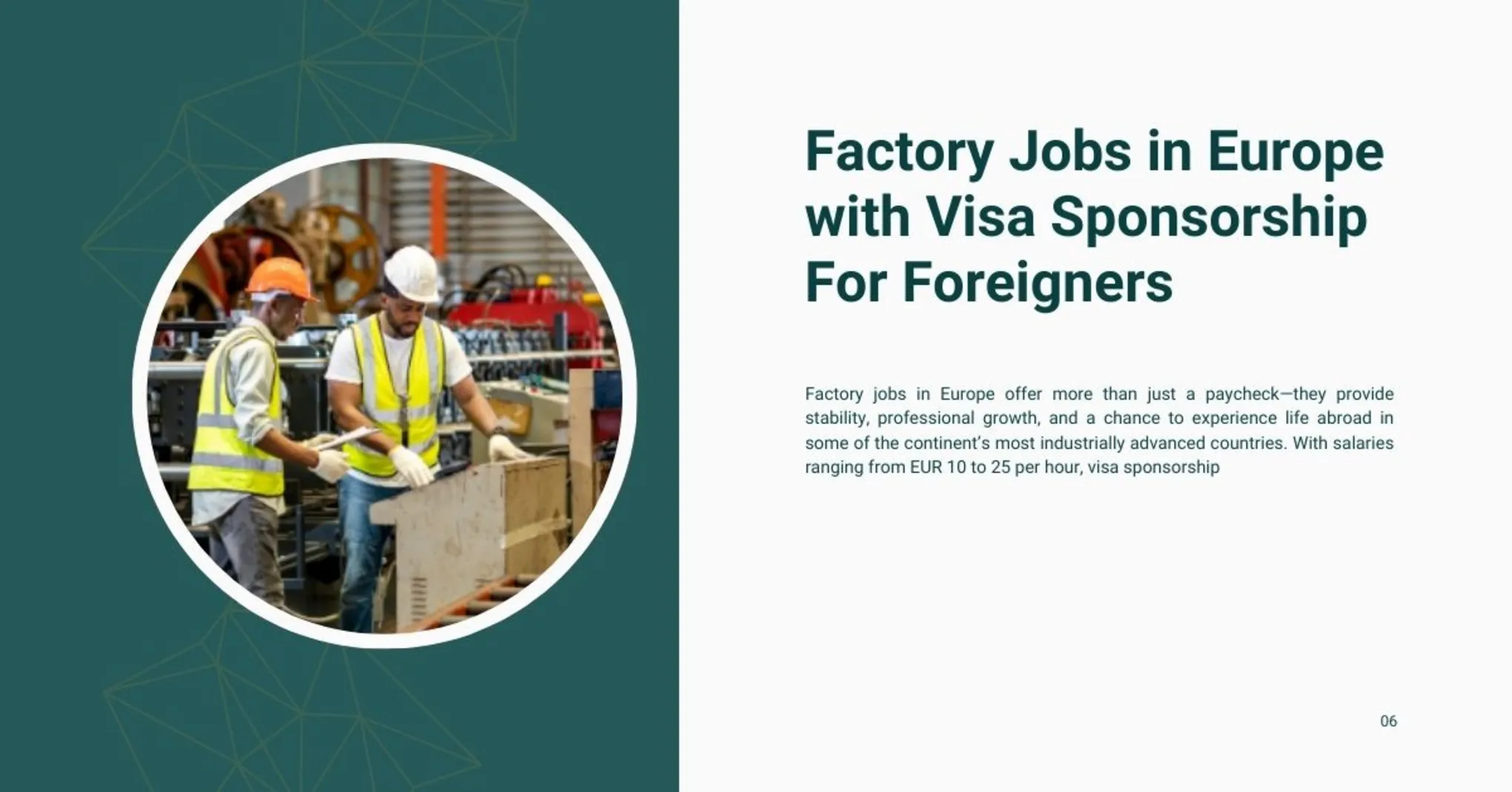
The Factory Jobs in Europe with Visa Sponsorship For Foreigners 2026 program offers a variety of manufacturing roles across Europe with salaries ranging from €28,000 to €32,000 per year, depending on location and experience. Successful candidates will perform duties such as machine operation, product assembly, inspection of finished goods, packaging, and maintaining workplace safety and hygiene standards. Many factories provide training and on-the-job support to ensure workers can meet European production quality requirements. Employers sponsor visas and assist with relocation, making it a practical pathway for international applicants to legally live and work in Europe. These positions are ideal for motivated individuals seeking reliable income, professional experience, and long-term career opportunities in the European manufacturing sector in 2026.
Why Work in Europe’s Factory Sector?
Europe’s advanced manufacturing sector offers more than just a job; it provides a foundation for a stable career with strong legal protections.
- Structured Pathways for International Workers: Countries like Germany, Poland, and the Netherlands have specific visa schemes (e.g., Germany’s Opportunity Card, Poland’s Work Permit) to address chronic labor shortages in skilled trades and industrial roles.
- Strong Labor Protections: EU labor laws guarantee fair wages, regulated working hours, generous paid leave, and safe working conditions.
- Skill Development & Certification: Many roles offer on-the-job training and opportunities to gain recognized European vocational qualifications, enhancing long-term employability.
- Competitive Wages & Social Benefits: Salaries are supplemented by comprehensive social security systems, including health insurance, pension contributions, and unemployment benefits.
- Potential for Long-Term Settlement: Stable employment is a key requirement for obtaining temporary residency, which can often lead to permanent residency (EU long-term resident status) after several years.
Details of Factory Jobs in Europe with Visa Sponsorship
Key Points
- Job Country: Primarily in countries with significant industrial bases and recognized labor shortages: Germany, Poland, the Czech Republic, the Netherlands, Austria, and Spain.
- Industry: Automotive, Metalworking & Machinery, Electrical Equipment, Food Processing, Pharmaceutical, Plastics.
- Job Type: Predominantly full-time, permanent contracts are the norm, offering job security.
- Experience Required: Varies widely. While some assembly line roles may require none, most employers seek candidates with proven experience or formal vocational training.
- Education Required: For skilled roles, a completed vocational apprenticeship or technical diploma in a relevant field (e.g., mechatronics, welding, industrial mechanics) is highly valued and often required.
- Visa/Work Permit: The process is usually initiated by the employer obtaining a work permit on your behalf, after proving no suitable EU candidate is available. Some countries also offer job-seeker visas (like Germany’s Opportunity Card) that allow you to search for work in person.
- Accommodation: Some employers, especially in remote industrial areas or through specific recruitment programs, may offer assistance in finding housing but rarely provide it for free.
- Typical Salary Range: €12–€22+ per hour gross, with significant variation by country, skill level, and industry.
Available Job Roles
The sector demands a range of profiles:
- Specialized Production Worker/Assembler: Performs complex assembly tasks, often in automotive or electronics, requiring precision and technical understanding.
- Certified Machine Operator/Setter: Operates, monitors, and performs basic maintenance on CNC machines, press lines, or automated packaging systems. Requires specific training.
- Industrial Maintenance Technician / Mechatronics Technician: A highly skilled role involving the installation, troubleshooting, and repair of factory machinery and robotic systems. This is a high-demand profession.
- Warehouse & Logistics Specialist (with Equipment Certification): Operates forklifts (requires a license) and manages inventory in high-tech logistics centers.
- Quality Control Inspector: Uses measuring tools and software to ensure products meet strict specifications. Requires an eye for detail and technical knowledge.
Requirements for Factory Jobs in Europe
Securing a position requires meeting both employer and immigration criteria:
- Formal Qualifications: For skilled positions, official certificates of your vocational training or degree are essential. These often need to be officially recognized or assessed for equivalence in the destination country.
- Relevant Experience: Employers prioritize candidates with 2-5 years of documented experience in a similar industrial setting. Detailed reference letters from past employers are crucial.
- Language Skills: A2/B1 level in the local language (German, Polish, Dutch, etc.) is increasingly a minimum requirement for safety, training, and team integration. English alone is typically only sufficient in multinational corporate settings or specific high-tech roles.
- Practical & Soft Skills: Technical aptitude, reliability, a strong work ethic, teamwork, and adherence to strict safety protocols are non-negotiable.
- Clean Criminal Record: A police clearance certificate is mandatory for the work permit/residency application.
Expected Wages
Gross monthly salaries vary considerably by country:
- Central/Eastern Europe (e.g., Poland, Czech Republic):
- Entry-Level/General Worker: €1,100 – €1,500
- Skilled Technician/Machine Operator: €1,500 – €2,200
- Western Europe (e.g., Germany, Netherlands, Austria):
- Entry-Level/General Worker: €2,200 – €2,800
- Skilled Technician/Machine Operator: €2,800 – €3,800+
- Certified Maintenance Technician/Meister: €3,500 – €4,500+
Note: These are gross salaries. Taxes and social security contributions are high but fund the extensive social benefits.
Benefits of Factory Jobs in Europe
Beyond the salary, employment comes with a robust social package:
- Comprehensive Social Security: Full coverage includes health insurance, pension contributions, unemployment insurance, and accident insurance.
- Generous Paid Leave: Legally mandated 20-30 days of paid annual vacation, plus paid public holidays and sick leave.
- Strong Job Security: Heavily regulated employment contracts make dismissal difficult without cause.
- Pathway to Integration: A stable job is the first step towards long-term residency, family reunification visas, and access to state integration/language courses.
Visa Requirements
Confirmed Job Offer from a European Employer
You must have a genuine offer from a factory or manufacturing company willing to sponsor your work visa.
Valid Passport
Your passport should be valid for the entire duration of your employment and visa.
Employer Visa Sponsorship
The employer must provide a certificate of sponsorship or work permit application to the relevant immigration authorities.
Labour Market Assessment (if required)
In some countries, the employer may need to demonstrate that no local or EU candidate is available for the position.
Age Requirement
Most countries require you to be at least 18 years old to work in factory settings.
Relevant Work Experience or Skills
Some factories may require prior experience or basic vocational skills related to the manufacturing process.
Medical Examination
A health check is often required to ensure you can safely perform factory duties.
Police Clearance Certificate
A clean criminal record from your home country (and any other countries you’ve lived in long-term) is typically required.
Language Skills (if applicable)
Basic knowledge of the local language may be required depending on the country and factory environment.
Temporary or Long-Term Work Visa Application
After receiving employer sponsorship, submit the visa application to the country’s immigration authorities, providing all required documents.
Proof of Accommodation and Living Arrangements
Some countries may require evidence that you have accommodation arranged during your stay.
Compliance with Immigration and Labour Laws
You must adhere to all legal requirements of the host country, including work permits, residence registration, and health insurance.
Visa Issuance and Entry
Once approved, the visa allows entry and legal employment in the factory for the duration specified in the contract.
How to Apply for Factory Jobs in Europe
The pathway is more formal than a simple job application:
- Research & Target: Identify countries with active shortage lists for your skill (e.g., check the German “Positivliste” or the Polish list of shortage occupations).
- Get Your Documents Recognized: Start the process of having your qualifications assessed for equivalence (e.g., through the German ZAB or other national agencies).
- Utilize Official Channels:
- EURES Portal: The official EU job mobility network, where employers post vacancies open to non-EU candidates.
- Specialized Recruitment Agencies: Reputable agencies in your home country that have contracts with European industrial firms (e.g., DIS AG, Work Service for Poland/CEE regions). Be wary of agencies asking for large upfront fees.
- Company Career Pages: Direct applications to major manufacturers (e.g., Volkswagen, Bosch, Siemens).
- Prepare a European-Style CV: Create a detailed, chronological CV listing all education, training, and work experience with dates and references.
- Secure the Job Contract First: A concrete job offer is mandatory before any work permit can be applied for. The employer then applies for pre-approval from the local immigration and labor authorities.
- Apply for the Visa/Work Permit: Once the employer receives approval, you apply for the relevant national work visa at the embassy in your home country.
Conclusion:
Factory jobs in Europe represent a robust and accessible opportunity for international workers. With the significant advantage of visa sponsorship, competitive wages protected by strong labor laws, and clear paths for skill development, these roles are more than just employment; they are a foundation for long-term career and personal growth in one of the world’s most desirable regions.
By methodically preparing your application and targeting the right job portals, you can successfully navigate the path to securing a sponsored position in Europe’s vital manufacturing sector.
Frequently Asked Questions
What is the salary range for factory jobs in Europe?
Salaries vary by role and country, but the general range is EUR 10 to 20 per hour. This typically results in a monthly income between EUR 1,800 and EUR 3,500, with higher wages in Western European nations like Germany and the Netherlands.
Do I need experience or a degree to apply?
For entry-level production or packing roles, no formal experience or degree is required. For skilled positions like machine operator or technician, 1-3 years of relevant experience or a technical diploma is generally preferred.